

The E27 Lamp Holder Material Guide: Ceramic vs Bakelite Sockets
Here are the main points to remember about E27 lamp holder materials. Keep these in mind for your next lighting project.
Key Takeaways
- Ceramic E27 lamp holders are best for high-heat situations because ceramic doesn't easily melt or break down.
- Always check the voltage and wattage ratings on the holder to make sure they match your bulb and power supply.
- Plastic holders can fail under continuous heat, making ceramic a safer choice for heat lamps or industrial lights.
- Proper installation is super important; ensure wires are connected securely to avoid electrical problems.
- Look for safety certifications like CE on your lamp holder to know it's been tested and meets safety standards.
Ceramic vs. Bakelite — The Thermal & Material Breakdown

 Right then, let's get down to brass tacks about lamp holders. When you're looking at an E27 socket, especially for anything that's going to run warm, the material is a big deal. It's not just about how it looks, though that's part of it. It's really about safety and how long the thing's going to last. We've got two main contenders here that people often ask about: ceramic and Bakelite.
Understanding Thermosetting Phenol Formaldehyde (Bakelite) Characteristics
Bakelite, or more accurately, thermosetting phenol formaldehyde resin, was one of the first synthetic plastics. It's known for being a decent electrical insulator, which is why it was used for so many electrical components back in the day. You'll often see a vintage style black E27 bakelite socket and think it's just the ticket for a retro build. And for some uses, it's perfectly fine. It's relatively cheap to produce and can be moulded into all sorts of shapes. However, it has its limits, particularly when it comes to heat. Continuous exposure to high temperatures can cause it to degrade over time. This degradation can lead to carbonisation and structural embrittlement, making the material brittle and prone to cracking. This isn't ideal, as it can compromise the socket's integrity and its ability to hold connections securely, potentially leading to arcing.
The Physics of Vitrified Kiln-Fired Porcelain Ceramic
Ceramic, specifically porcelain, is a different beast altogether. It's made from clay that's fired at very high temperatures in a kiln. This process vitrifies the material, making it incredibly hard, dense, and non-porous. When we talk about a high temperature E27 porcelain screw socket, we're talking about something that's built to last and handle serious heat. Ceramic has excellent dielectric insulation capacity and, crucially, it doesn't degrade when subjected to prolonged heat. Unlike plastics, it won't warp, melt, or become brittle. This makes it the go-to choice for applications where heat is a significant factor, such as with older incandescent bulbs or specific heating lamps. For more on the properties of different materials used in composites, you might find research on commercial polymers interesting.
Technical Specification Comparison Matrix
To make it clearer, here's a quick rundown of how they stack up:
| Feature | Ceramic (Porcelain) | Bakelite (Phenol Formaldehyde) |
|---|---|---|
| Heat Resistance | Excellent; handles high temperatures without degrading | Moderate; degrades with continuous heat exposure |
| Durability | High; brittle, but resistant to deformation | Moderate; can become brittle and crack with heat |
| Electrical Insulation | Excellent | Good (initially); can degrade with heat/age |
| Thermal Stability | Very High | Moderate |
| Resistance to Ageing | Excellent | Fair; susceptible to thermal degradation |
| Typical Use | High-heat, industrial, permanent installs | Low-wattage, decorative, temporary use, vintage style black E27 bakelite socket applications |
When choosing between ceramic and Bakelite, consider the intended use. For anything that will generate significant heat or be in use for extended periods, ceramic is the safer and more durable option. Bakelite has its place, but it's best suited for lower-demand applications where heat build-up isn't a primary concern.
Trade and High-Load Applications: When Ceramic is Mandatory
Agricultural and Vivarium Heating Requirements: Managing Continuous Infrared Loads
When you're dealing with setups that need consistent, high temperatures, like those found in agricultural settings or for reptile keepers, ceramic E27 lamp holders are pretty much the only sensible choice. Think about incubators or reptile tanks; they rely on lamps that run for hours on end, sometimes days. Plastic sockets just can't handle that kind of sustained heat without eventually degrading, becoming brittle, and posing a fire risk. Ceramic, however, is built for this. Its vitrified clay porcelain housing is designed to manage significant heat without warping or melting. This makes it ideal for holding industrial porcelain lampholders for heating lamps, especially when you're using infrared ceramic heat emitter arrays that pump out serious warmth.
- Thermal Stability: Ceramic doesn't deform or break down under prolonged high temperatures.
- Durability: It resists corrosion and general wear and tear, leading to a longer service life.
- Safety: A stable socket minimises the risk of electrical faults caused by heat stress.
For any application involving high heat output, always double-check the maximum wattage rating of the lampholder against the bulb you plan to use. Overloading a socket, even a ceramic one, can still lead to problems.
Why Upgrading to High-Temperature E27 Porcelain Screw Sockets Saves Circuits
If you've ever had a lighting circuit trip unexpectedly or noticed a faint smell of burning plastic around a fitting, it might be down to the lampholder. Standard plastic sockets have a lower maximum thermal load threshold. When a high-wattage bulb, especially an older incandescent type that converts a lot of energy into heat, is used, this heat can stress the plastic. Over time, this leads to material fatigue, poor electrical contact, and potentially dangerous overheating at the terminals. Upgrading to a high-temperature E27 porcelain screw socket is a straightforward way to prevent these issues. The robust ceramic construction offers superior insulation and heat dissipation, protecting the wiring and preventing premature failure of the circuit. It's a small change that significantly boosts the reliability and safety of demanding installations, and it's often a requirement for commercial setups like greenhouse lighting.
| Feature | Plastic Socket | Ceramic Socket |
|---|---|---|
| Max Temp | Typically < 150°C | Up to 600°C+ |
| Thermal Degradation | Prone to melting, warping, becoming brittle | Highly resistant to heat damage |
| Suitability | Low-wattage, decorative, temporary use | High-wattage, industrial, permanent installs, heating |
| Lifespan | Shorter under high heat | Significantly longer under high heat |
Electrical Compliance, UK Wiring Standards, and Safe Installation

Right then, let's talk about making sure your lighting setup is up to snuff with UK regulations. It's not just about screwing in a bulb; there are rules to follow, especially when you're dealing with anything beyond a standard table lamp. We're talking about safety, plain and simple, and that means understanding what's what.
Satisfying BS EN 60238 Regulations for Screw-Thread Lampholders
When you're looking at E27 lamp holders, especially for anything that might be considered a heavy duty heat bulb holder UK, you absolutely need to be aware of BS EN 60238. This is the standard that covers screw-thread lampholders, and it lays out the requirements for safety and performance. It dictates things like the physical dimensions, electrical properties, and mechanical strength. For instance, it specifies how the lampholder should grip the lamp cap, the insulation requirements, and how it should perform under various temperature conditions. Making sure your chosen holder meets this standard is your first line of defence against potential hazards. You'll often see this standard referenced on packaging or in product specifications, and it's a good sign that the product has been designed with safety in mind. It's all about ensuring that the connection between the lamp and the mains supply is secure and stable, preventing issues like lamps falling out or electrical faults.
Critical Safety Callout Box
Always disconnect the mains power at the fuse box before attempting any wiring. Double-check that the power is off using a voltage tester. Never work on live circuits.
Preventing Terminal Arcing and Conductor Failure: Electrician-Level Installation Tips
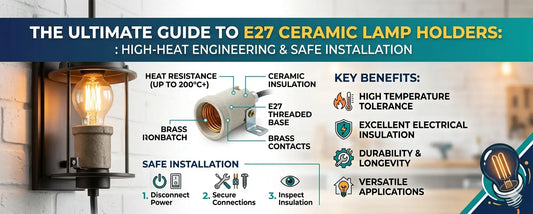
Getting the wiring right is absolutely key to preventing problems down the line. We're talking about avoiding terminal arcing and conductor failure, which can lead to overheating and, frankly, fires. For a solid connection, you want to use lampholders with robust "E27 Edison Screw (ES) brass terminals". These provide a good, firm grip on the conductors. When you're stripping the wires, make sure you only strip enough insulation to get a good wrap around the terminal screw, usually about 10-12mm. Any more and you risk exposed copper touching other parts. Any less, and you won't get a secure connection. Tighten those terminal screws down firmly – not so much that you strip the thread, but enough so that the conductor is held fast. A loose connection is a prime spot for resistance to build up, which generates heat. This heat can degrade the insulation over time, leading to further problems. For mains 230V AC current stability, a good connection is non-negotiable. It's also worth considering the galvanic integrity of your connections, especially in environments prone to moisture, to prevent corrosion which can also increase resistance. If you're unsure about wire gauge or termination techniques, it's always best to consult with a qualified electrician or refer to specific wiring guides for your installation. For example, if you're installing a high-power heat lamp, you'll need to ensure your wiring and connections can handle the load, which might mean using thicker gauge wire than you would for a standard LED bulb. You can find suitable lampholders designed for continuous operation on sites that specialise in lighting components.
INSERT STEP-BY-STEP ASSEMBLY SEQUENCE
Here’s a straightforward sequence for wiring a typical ceramic E27 lampholder:
- Isolate Power: Ensure the circuit you're working on is completely dead. Turn off the relevant breaker or remove the fuse.
- Prepare the Lampholder: If it's a two-part holder, separate the base from the top. You'll see the terminals inside the top section.
- Prepare the Cable: Strip approximately 10-12mm of outer insulation from the mains cable. Then, strip about 5-8mm of insulation from the individual conductors (Live, Neutral, and Earth if applicable).
- Connect Live and Neutral: Identify the Live (usually brown wire) and Neutral (usually blue wire) conductors. Connect the Live conductor to the terminal marked 'L' and the Neutral conductor to the terminal marked 'N'. Ensure the copper strands are neatly twisted and fully inserted under the screw head before tightening securely.
- Connect Earth (if applicable): If your lampholder and cable have an Earth connection (usually green/yellow wire), connect it to the terminal marked with the earth symbol.
- Secure and Reassemble: Check that all conductors are firmly held and no stray strands are exposed. Carefully reassemble the lampholder, ensuring the wires are not pinched. If you're using a Cermic E27 lampholder,a always check for any specific wiring instructions they might provide, though ideally, you'd stick to known, certified brands.
Frequently Asked Questions: Material Choice, Load Limits, and Safety
Right then, let's clear up a few common questions about picking the right E27 lamp holder. It's not just about screwing in a bulb; there's a bit more to it, especially when you're dealing with heat and safety.
What's the main difference between ceramic and Bakelite holders when it comes to heat?
Ceramic, particularly porcelain, is fired at very high temperatures. This makes it incredibly stable and resistant to heat. It won't degrade, warp, or become brittle even with prolonged exposure to high temperatures, which is why it's the go-to for demanding applications. Bakelite, on the other hand, is a thermosetting plastic. While it's better than some other plastics, it has its limits. Continuous high heat can eventually cause it to degrade, potentially leading to issues like cracking or becoming brittle over time. For anything that runs hot for extended periods, like agricultural heating or certain industrial lights, ceramic is the only sensible choice.
- Heat Resistance: Ceramic excels, Bakelite is moderate.
- Durability: Ceramic is brittle but stable; Bakelite can warp or crack.
- Longevity: Ceramic generally lasts much longer under thermal stress.
How do I know if a lamp holder can handle the bulb I want to use?
This is where the technical specs come in. You'll see ratings for voltage and amperage, usually printed on the holder itself or its packaging. For most E27 holders, you'll see a 250V rating, which is standard for UK mains. The amperage rating, often 2A or 4A, tells you how much current it can safely handle. To figure out if your bulb is compatible, you can calculate its current draw: Amps = Watts / Volts. For example, a 60W LED bulb on a 230V supply draws about 0.26A, well within the limits of a 2A or 4A holder. However, if you're using older, high-wattage incandescent bulbs or specific heat lamps, you must check their wattage and calculate the current draw carefully. Never exceed the holder's rated amperage or wattage. It's a direct route to overheating and a fire risk.
Are there specific installation points I need to be aware of, especially with wiring?
Absolutely. The connection points are critical. You want a secure connection to prevent resistance build-up, which generates heat. Look for holders with robust internal terminal blocks. When wiring, use the correct gauge wire for the expected current. Too thin, and it overheats; too thick, and it might not seat properly. For typical 2A or 4A rated holders, 1.0mm² or 1.5mm² (around 16-18 AWG) cable is usually suitable, but always check the specific requirements. Pay attention to the integrated M10 metal cord grips if your fixture uses them, ensuring they clamp the cable's outer sheath securely without damaging the insulation. Also, consider the creepage distance and clearance constraints designed into the holder to prevent electrical tracking, especially in environments where dust or moisture might be present.
When installing, always ensure the wires are stripped to the correct length and fully inserted into the terminals. A loose wire is a common cause of overheating and arcing, even in a high-quality ceramic holder. Tighten terminal screws firmly but without overtightening, which could damage the terminal block.
Conclusion
So, we've gone through the ins and outs of E27 lamp holders, focusing on ceramic and Bakelite. It's pretty clear that when it comes to handling heat and ensuring a safe connection, ceramic really shines. While Bakelite and other plastics have their place, they just can't match ceramic's resilience in high-temperature situations. Whether you're fixing up a vintage piece, setting up a heat lamp for your pets, or just want a reliable socket for a regular lamp, choosing the right material is key. Don't overlook this small but vital component – it’s all about safety and making sure your lights work as they should, for a long time. Stick with ceramic for those demanding jobs; it's a choice you won't regret.
Frequently Asked Questions
Can I use any E27 bulb in a ceramic lamp holder?
Generally, yes. The 'E27' just means the bulb has a standard screw base about 27mm wide. Most household bulbs will fit. Just make sure the bulb's wattage isn't higher than what the holder can handle. Overloading it can be dangerous.
Are ceramic lamp holders safer than plastic ones?
For places that get really hot, like near a heat lamp or in some workshops, ceramic is much safer. Plastic can get soft, warp, or even melt when it's too hot. Ceramic can handle way higher temperatures without any issues. For regular lamps, plastic is often fine, though.
What does 'E27' mean on a lamp holder?
The 'E' stands for Edison, like the inventor of the screw-in bulb. The '27' is the size in millimeters across the threads of the bulb's base. So, an E27 holder is made for a bulb with a 27mm screw base. It's the common size used in Europe and many other places.
How do I know if my ceramic E27 lamp holder is safe?
Look for safety marks on the holder or its packaging. Things like 'CE' (for Europe) mean it's been tested and meets safety rules. If you can't find any marks, it's probably best not to use it, especially for jobs where it will get hot.
Can I install a ceramic E27 lamp holder myself?
If you're comfortable with basic electrical wiring and remember to turn off the power first, you can often do it yourself. But if you have any doubts at all, it's always safer to call a qualified electrician. Getting the wiring wrong can be seriously dangerous.
What's the highest wattage bulb I can use with a ceramic E27 holder?
This is really important! The holder will have a maximum wattage number, usually printed on it or the box. You absolutely must not use a bulb with a higher wattage than the holder is rated for. Using too much power can cause it to overheat and start a fire.
Labels:
Gerelateerde artikelen

Light Solutions for Windowless Rooms
Jun 04 2026