LED Panel Lights vs Downlights: Which Suits Your Space?
If you're planning a lighting upgrade, two names come up again and again: LED panel lights and LED downlights. Both give you clean, modern, energy-efficient illumination — but they're built for different jobs. Choosing the wrong one can leave a room over-lit and clinical, or under-lit and gloomy. In this guide, we'll break down exactly how each one works, where they perform best, and how to decide which is right for your space.
What Are LED Panel Lights?
An LED panel light is a thin, flat fixture — usually rectangular or square — that mounts flush to the ceiling or recesses into a suspended ceiling grid. Instead of a single point of light like a bulb, a panel light uses an array of LEDs spread evenly behind a diffuser, so the whole surface glows uniformly. That's what gives panel lights their signature soft, shadow-free spread of light.
Panel lights are typically sized around 300x300mm, 600x600mm, or 1200x600mm, which makes them a natural fit for suspended ceiling tiles in offices, but increasingly popular in kitchens, home offices, and utility rooms too, where even, glare-free light matters more than decorative styling.
Where LED panel lights work best
- Kitchens — even light across worktops with no harsh shadows while chopping or cooking
- Home offices and studies — reduced glare on screens, consistent brightness across the desk
- Utility rooms, garages, and workshops — maximum coverage for practical tasks
- Commercial and retail spaces — large, even coverage at a lower cost per lumen than multiple downlights
What Are LED Downlights?
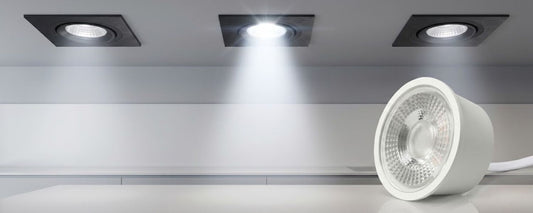
A downlight (sometimes called a recessed spotlight or ceiling spot) is a small, round or square fixture recessed into the ceiling, directing light downward in a focused beam. Rather than lighting a whole surface evenly, downlights are placed in a pattern across a ceiling to build up layered, directional lighting.
Because each downlight is small and discreet, they sit almost flush with the ceiling and barely register visually — which is exactly why they're the go-to choice when you want the room to be about the furniture, the walls, or the architecture, not the light fixture.
Where LED downlights work best
- Living rooms and bedrooms — a soft, layered look, often paired with lamps or wall lights
- Bathrooms — compact, and available in IP-rated versions safe for wet zones
- Hallways and stairwells — spaced along a route for consistent, guided lighting
- Feature lighting — highlighting artwork, alcoves, or architectural detail
Quick rule of thumb: if the room is a workspace where you need flat, even brightness (kitchen, office, garage), lean toward panel lights. If the room is about ambience and layered light (living room, bedroom, hallway), lean toward downlights.
LED Panel Lights vs Downlights: Key Differences
| Feature | LED Panel Lights | LED Downlights |
|---|---|---|
| Light spread | Wide, even, edge-to-edge | Focused, directional beam |
| Best for | Task lighting, large open areas | Ambient and accent lighting |
| Typical size | 300–1200mm | 70–200mm diameter |
| Number needed per room | Usually 1–2 for full coverage | Several, spaced across the ceiling |
| Visual footprint | Visible flat fixture | Near-invisible, flush with ceiling |
| Typical install | Surface-mounted or grid-recessed | Recessed into ceiling void |
| Dimmable options | Yes (check product listing) | Yes, widely available |
Shop the Range
Browse some of our best-selling panel lights and downlights below — all in stock and ready to ship.

5W Recessed Round LED Panel Downlight 6000K
£4.96 £5.51
View Product
Slim Square LED Recessed Downlight
£3.94 £4.38
View Product
Ultra Slim IP44 LED Panel Spotlight
£10.99 £13.49
View Product
Round Panel Downlight — 5 Pack
From £4.64 each
View ProductWhich Suits Your Space? A Room-by-Room Guide
Kitchen
Most kitchens benefit from a mix: a panel light or two over the main prep area for flat, shadow-free brightness, paired with smaller downlights around the perimeter or over an island for layering. If your kitchen has a suspended ceiling or a flat plasterboard ceiling with no room to recess, a slim surface-mounted panel light is often the simplest install. See our full kitchen lighting collection for more ideas.
Living Room
Downlights are the more common choice here, spaced evenly across the ceiling or arranged around the room's perimeter to wash light down the walls. They sit quietly in the background, letting your furniture and decor do the visual work — browse our living and dining room lighting for matching pieces.
Home Office
This is where panel lights shine — literally. Even, glare-controlled light reduces eye strain during long hours at a screen. A single larger panel centred over the desk area typically outperforms multiple downlights for this specific task, especially paired with a dimmable driver so you can ease off the brightness in the evening.
Bathroom
Downlights with an appropriate IP rating (IP44 for general zones, IP65 for shower zones) are the standard here, spaced to avoid shadows across the mirror and vanity area. Panel lights are less common in bathrooms simply due to their larger size relative to most bathroom ceilings — our IP44-rated slim panel downlights are a popular pick for splash zones.
Hallways and Stairs
Downlights spaced along the route give consistent, guided lighting without visual clutter — ideal for narrow spaces where a panel light would look oversized. See our hallway lighting range for options.
Installation and Cost Considerations
Panel lights generally cost more per unit but you need fewer of them to light a room, since one panel can cover the same area as several downlights. Downlights cost less individually but the total project cost can add up once you factor in the number of fittings, plus the electrician's time to cut multiple ceiling holes and run cabling to each one.
If you're working with a suspended ceiling (common in offices and some kitchens), panel lights are usually the easier and tidier install — they drop straight into the existing grid. If you're working with a solid plasterboard ceiling and want a lower-profile, more discreet finish, downlights are typically the better fit, provided there's enough void depth above the ceiling for the fitting.
Always check the ceiling void depth before ordering downlights — standard downlights need roughly 25–75mm of clearance, though low-profile options are available for shallower ceilings. Make sure any driver or transformer you pair with your fittings is correctly rated — see our LED transformers and drivers for compatible options.
Energy Efficiency: Panel vs Downlight
Both are highly efficient compared to older halogen or fluorescent fittings, but the real-world efficiency comes down to how many fittings you actually need. A single 36W panel light might replace what would otherwise take six or more 5–7W downlights running simultaneously — so total wattage and running cost depend more on your layout than on the fixture type itself. As a general guide, aim to match total lumen output to the room's use: around 300–500 lumens per square metre for general living spaces, and closer to 500–700 lumens per square metre for kitchens and workspaces.
Still not sure which is right for your room?
Browse our full lighting range or get in touch — we're happy to help you plan the right layout for your space.
Get Lighting AdviceFrequently Asked Questions
Can I mix LED panel lights and downlights in the same room?
Yes — this is actually one of the most common approaches, especially in kitchens and open-plan living spaces. Use a panel light for the main task area and downlights around the perimeter for layered ambient light.
Are LED panel lights brighter than downlights?
A single panel light typically outputs more total lumens than a single downlight, but the difference is about coverage, not just brightness. A panel spreads its light evenly across a wide area, while a downlight concentrates its light in a smaller, more focused beam.
Do downlights need a fire-rated cover?
If the downlight is recessed into a ceiling that separates floors (such as a ground floor ceiling below an upstairs room), UK building regulations generally require a fire-rated downlight or a fire hood to maintain the ceiling's fire resistance.
Can LED panel lights be used in a home instead of just offices?
Yes. While panel lights are strongly associated with commercial ceilings, slimline surface-mounted panel lights are increasingly popular in kitchens, utility rooms, and home offices where even, glare-free light is a priority.
What IP rating do I need for a bathroom downlight?
Use at least IP44 for general bathroom zones, and IP65 for downlights installed directly above a shower or bath where they may be exposed to water spray.
Are LED panel lights or downlights cheaper to install?
Downlights are cheaper per unit, but you'll typically need more of them to light the same area, which can increase both material and installation cost. Panel lights cost more individually but often need fewer fittings to achieve full coverage, particularly in larger rooms.
Final Thoughts
There's no single "better" option between panel lights and downlights — it comes down to what the room needs to do. Task-focused spaces like kitchens, offices, and workshops usually call for the even, wide-reaching output of a panel light. Spaces built around comfort and atmosphere — living rooms, bedrooms, hallways — usually suit the quieter, layered look of downlights. Many rooms genuinely benefit from both working together.
Explore our full LED panel light and downlight range to find the right fit for your space, browse dimmable lighting for extra control, or check out our outdoor lighting if you're extending the project beyond the ceiling.
Labels: